
'We have to be prepared on the borders to withstand Chinese expansionist designs.'
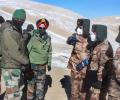
The talks are following up the outcome of the 19th round of Corps Commander-level talks held between the two sides on August 13-14 at the Chushul Moldo border meeting point.

Corporal Wang Ya Long was handed over to the Chinese military on Tuesday night at Chushul-Moldo border point in eastern Ladakh, the sources said in New Delhi.

These missiles have a range of two to five km and they are capable of bringing down low flying helicopters and aircraft, they added.

Military experts said the aim of constructing the bridge in the Khurnak area could be to ensure that the Chinese People's Liberation Army is able to quickly mobilise its troops in the region.
India and China on Tuesday agreed to hold the next round of the Senior Commanders meeting at an early date to achieve complete disengagement from all friction points in eastern Ladakh to create conditions for the restoration of normalcy in bilateral ties.

The sources also said another round of military talks between the two sides on Wednesday to defuse tensions in the area remained inconclusive. The talks lasted nearly seven hours.
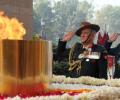
"The force is to maintain peace and tranquillity at the border but it will not shy away from flexing its muscles, if the need be," Gen Rawat said.

Until last month more than two-thirds of the Indian Army was deployed against Pakistan. Of 14 army corps, just four-and-a-half faced China, while more than twice that number was ranged against Pakistan.

Siachen 1987 reveals for the first time the Northern Army's 'intent' to use Siachen as an excuse to capture the strategic town of Skardu in PoK, notes military historian Colonel Anil A Athale (retd).

As part of the mega plan, around 20 bridges, a number of tunnels, airbases and several key roads are being developed in strategically key areas in Arunachal Pradesh to bolster the overall military preparedness, officials said on Monday.

Col Babu was awarded the gallantry medal for resisting the Chinese Army attack while establishing an observation post in the face of the enemy in the Galwan valley in the Ladakh sector during Operation Snow Leopard.
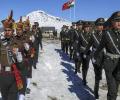
Sources said India will not lower its guard and will maintain the current state of very high-level of combat readiness in eastern Ladakh till there are visible changes in the ground situation.
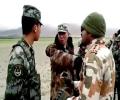
India has significantly enhanced military infrastructure, surveillance and combat capabilities along the nearly 3,500 km-long Line of Actual Control (LAC) with China since the deadly clashes in Galwan valley in 2020, sources in the defence establishment said Wednesday on the eve of the third anniversary of the hostilities.
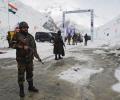
With Beijing remaining intransigent on the withdrawal of additional troops deployed by the People's Liberation Army (PLA) since the deadly border clash in 2020 in eastern Ladakh, India's bilateral ties with China remained frozen in 2023 with no forward movement on the horizon despite several rounds of diplomatic and military talks.

The incident had taken place at a time when the Indian Foreign Minister, S Jaishankar, was in Moscow for the Shanghai Cooperation Organisation meeting, where he met his Chinese counterpart to address the border issues.

Disengagement from the LAC will remain a chimera because China has given enough indications that the PLA will not move back any more. China has even deployed drones to monitor and deny any patrolling by Indian troops even in the buffer zones which are all in Indian Territory, explains Lieutenant General Prakash Katoch (retd).

The names of 20 Indian Army personnel, who were killed while valiantly fighting Chinese troops in Galwan Valley in eastern Ladakh in June last year, were inscribed on the National War Memorial ahead of the Republic Day, official sources said.
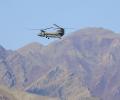
As soon as one lands at the Leh airfield, one can see the Indian Air Force C-17s, Ilyushin-76s, and C-130J Super Hercules aircraft flying in with rations and supplies for the troops deployed on the forward locations opposite the Chinese forces.

'China is unwilling to restore the status quo ante of April 2020.' 'India will have to weigh its options based on this premise.'
'The Indian government wakes up after the fact when it can do nothing, or rather lacks the will to prosecute military actions to reverse these adverse PLA-driven developments.'
'The Arunachal border is not demarcated in that way, so there can be differing perceptions (between two sides)'

India's relations with China cannot be normal as long as Beijing tries to unilaterally change the Line of Actual Control and continues to build up forces along the border, External Affairs Minister S Jaishankar said on Wednesday.
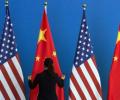
Throughout its standoff with India along the Line of Actual Control (LAC), Chinese officials sought to downplay the severity of the crisis, emphasising Beijing's intent to preserve border stability and prevent the standoff from harming other areas of its bilateral relationship with India, the Pentagon said in a report on Tuesday.

Newly-appointed Army Chief General Manoj Pande on Sunday said his 'utmost and foremost' priority would be to ensure very high standards of operational preparedness to face current, contemporary and future security challenges across the entire spectrum of conflict.
When asked for an update on Tuesday's military-level talks, Chinese foreign ministry spokesperson Hua Chunying told a media briefing in Beijing that both sides reached progress for promoting further disengagement of the border troops at the Western Sector.

The Army said it was also highlighted that completion of disengagement in other areas would pave the way for the two sides to consider de-escalation of forces and ensure full restoration of peace and tranquillity and enable progress in bilateral relations.
According to the 'Military and Security Developments involving the People's Republic of China' report 2023: "Since early May 2020, sustained tensions along the India-China border have dominated the Western Theater Command's attention."

The Army has also further bolstered overall surveillance mechanisms in all areas along the Line of Actual Control (LAC) in eastern Ladakh after foiling China's fresh attempt to occupy an area on the southern bank of Pangong lake, they said.

The armies of India and the US on Tuesday began an over two-week mega military exercise at a military facility in Uttarakhand with the aim of exchanging best practices and tactics in sync with growing defence ties between the two countries.
At present, the Chinese Army has diverted its troops carrying out a massive exercise on their side of the LAC and deployed them at short notice across the Line of Actual Control in the areas under the Indian Army's 81 and 114 Brigades deployed to counter the Chinese assertions from Daulat Beg Oldie and adjoining areas.
Indian Army Chief General M M Naravane had said on Wednesday that India was hopeful of resolving issues related to disengagement at Patrolling Point 15 (Hot Springs) in eastern Ladakh in the 14th round of talks.
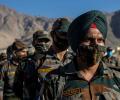
'China is mindful of the fact that it is not confronting the Indian Army of 1962. But the sabre rattling will continue.'
The Indian side also told the Chinese delegation that the talks on disengagement should include Depsang as well as all face-off sites, insisting that it should be a simultaneous process and not a selective one.

Reports (not denied by India) that the USA had 'for the first time provided real-time details to their Indian counterparts on the Chinese positions and force strength in advance of a PLA incursion' into Tawang at the LAC in December 2022, helping India thwart China's expansionist designs, show how operationally effective the USA-India friendship has become on the ground. A engaging excerpt from Sreeram Chaulia's must-read new book, Friends: India's Closest Strategic Partners.

The disengagement of troops of the Indian Army and China's People's Liberation Army from the Line of Actual Control was reached after sustained negotiations at the military and diplomatic level, said the ministry of external affairs last week.
The meeting primarily focused on implementation of certain decisions taken at the fifth round of talks between Corps Commanders of the two armies last week on the disengagement process as well as to bring down prevailing tension in the region, sources said.

The Chinese and Indian armies continued with the disengagement process in the North and South banks of Pangong lake in eastern Ladakh as per plan and the entire pullback exercise is expected to take another six-seven days, sources in the defence and security establishment said on Monday.

Lance Naik Albert Ekka, Param Vir Chakra, was only 28 when he made the supreme sacrifice for the Motherland.
A joint statement released on Thursday said both sides exchanged views in an 'open and constructive' manner to resolve the 'relevant issues' and that it was agreed to maintain 'security and stability' on the ground in the region.
 © 2026 Rediff.com - Advertise with us - Disclaimer - Privacy Policy - Sitemap - Feedback - About us - Terms of use - Grievances